

ATA Carnets Have Gone Digital:
What the 2026 Changes Mean for Your Business
If your business regularly sends goods overseas for exhibitions, trade shows, product demonstrations or temporary projects, you’ll probably already be familiar with ATA Carnets. For years, they have simplified temporary exports by removing the need to pay import duties and taxes in every country you visit.
Now, the system has undergone its biggest change in decades.
From 1 June 2026, the UK joined the first phase of the international eATA Carnet programme. This introduced digital processing for ATA Carnets alongside the European Union, Norway and Switzerland. While the purpose of an ATA Carnet remains exactly the same, the way it is presented and processed at customs has changed significantly.
If you’re planning temporary exports, here’s what you need to know.
What is an ATA Carnet?
An ATA Carnet is an international customs document that allows goods to be temporarily exported and imported without paying customs duties or import VAT. However, this applies only if the goods are returned within the carnet’s validity period.
It acts as a passport for goods. As a result, it makes temporary international movements much simpler than completing full customs declarations every time a shipment crosses a border.
ATA Carnets are commonly used for:
- Exhibition and trade show equipment
- Professional equipment used overseas
- Commercial samples
- Demonstration products
- Sporting equipment
- Musical instruments
- Film and television production equipment
Rather than paying import charges in every country you visit, the carnet guarantees those duties while the goods remain temporarily abroad. Once the goods return home, the carnet is discharged. Therefore, no import duties become payable, provided all customs procedures have been correctly completed.
For businesses attending multiple exhibitions or visiting several countries with the same equipment, an ATA Carnet can save both time and considerable expense.
Who typically needs an ATA Carnet?
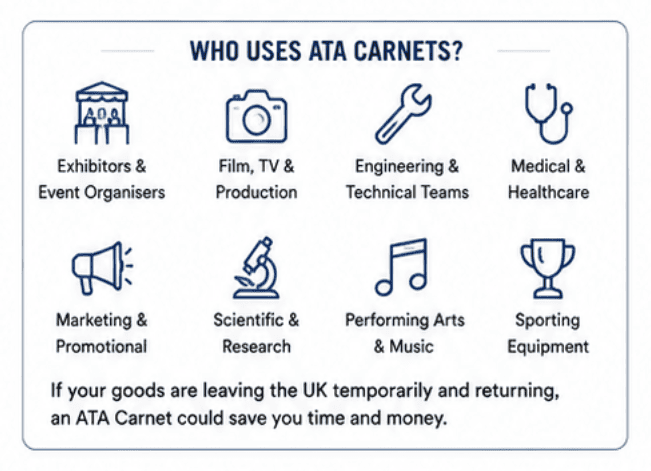
Many industries rely on ATA Carnets without realising just how often they use them.
Typical users include:
What’s changed?
Until recently, ATA Carnets were entirely paper-based.
Every movement required customs officers to stamp the carnet booklet and remove the relevant voucher as goods entered or left each country. Additionally, losing the booklet or missing a customs endorsement could lead to lengthy investigations. In some cases, this resulted in unexpected customs claims.
That process is now changing.
From 1 June 2026, the UK became one of the first countries to adopt the new eATA Carnet system. Together with the European Union, Norway and Switzerland, customs authorities can now process carnet movements digitally.
Instead of relying solely on a paper booklet, carnet holders use the official ATA Carnet app to present a secure QR code at customs. Therefore, customs officers scan the code, allowing each import, export and re-export movement to be recorded electronically.
This creates a digital record of the journey while reducing paperwork and improving visibility throughout the temporary export process.
The International Chamber of Commerce intends to extend the digital system worldwide over the coming years. Furthermore, global implementation is expected by 2028.
What does this mean for your business?
The good news is that the purpose of an ATA Carnet hasn’t changed.
If your goods qualify today, they’ll continue to qualify under the new digital system. The temporary admission rules, eligibility requirements and responsibility for returning the goods all remain exactly the same.
The difference is how those movements are managed.
Businesses should now expect to:
- Use the official ATA Carnet app when travelling between participating countries
- Present a QR code to customs instead of relying solely on paper documentation
- Ensure the person accompanying the goods understands the digital customs process
- Confirm that every customs crossing is correctly recorded electronically
As more countries adopt the eATA system, digital processing will gradually become the standard method for temporary exports.
How does this affect freight forwarders?
While the process becomes more digital, planning remains just as important.
As experienced freight forwarders, we now help clients prepare for both the customs requirements and the digital procedures before goods leave the UK.
This includes confirming whether the destination country supports eATA processing and ensuring the correct documentation has been arranged. It also involves advising who should present the carnet at customs. In addition, we help businesses understand how the digital process works before they travel.
For companies attending overseas exhibitions or sending valuable equipment abroad, a little preparation can prevent costly delays at the border.
What should you do now?
If your business uses ATA Carnets, there is no need to worry, but there are a few practical steps worth taking.
- Ensure the employee or representative travelling with the goods is familiar with the ATA Carnet app. In addition, they should understand what will happen at customs.
- Review any upcoming temporary exports and check whether your destination is participating in the eATA programme.