ICS2 Phase 3:

What Importers & Exporters Need to Know Before the September 2025 Deadline

At Future Forwarding, we make it our mission to keep our clients informed about upcoming regulatory changes that may impact the flow of goods through global supply chains. Whether you are seeking advice on customs concerns, airfreight procedures, ocean freight management, road freight strategies, imports handling, exports processes, or navigating ICS2 regulations, we are here to help.

The Import Control System (ICS), and more recently ICS2 (Import Control System 2), is an EU-wide customs pre-arrival security program. It aims to collect data about goods entering the EU before they arrive, for safety and security risk analysis. ICS2 is being rolled out in phases, each focusing on different types of operators and transportation modes.

Who it affects: Express carriers and designated postal operators (under UPU regulations) transporting goods by air into the EU.

Phase 1 – Air Express and Postal Pre-loading (March 2021)

What’s required: Submitting a minimum dataset called Pre-loading Advance Cargo Information (PLACI) before loading at the airport of departure.

Why: To enable early security risk assessment before goods are loaded onto the aircraft bound for the EU.

Phase 2 – Air Cargo and General Air Transport (March 2023)

Who it affects: All air cargo general transport operators, freight forwarders, logistics providers, and postal operators (beyond PLACI)

What is required?

  • A complete Entry Summary Declaration (ENS) dataset, including detailed information from multiple supply chain actors.
  • Ensures a multi-filer approach, where different parties provide segments of the ENS.

Why: Allows customs to assess risks more comprehensively across the full air supply chain.

What’s Changing in Phase 3?

Phase 3 – Maritime, Road, Rail, and Remaining Postal Flows (Starting March 2024 and ongoing into 2025)

Phase 3 marks the final rollout of ICS2 and comes into force in September 2025. It extends mandatory requirements to various sectors, including airfreight, sea freight, rail, and road freight carriers, reflecting the comprehensive scope of freight management and its linkage to customs regulation.

Who it affects: Operators in sea, inland waterways, rail, and road transport, including remaining postal and express shipments not yet covered.

What is required?

  • Filing ENS for all modes of transport, including deep sea, short sea, and land modes.
  • Alignment with new business rules and data requirements under ICS2..

Rollout Schedule: Gradual onboarding from March 2024 through to 1st October 2025, with deadlines depending on the operator type and Member State readiness.

Why It Matters for Your Business

If you’re importing into or transshipping through the EU, ICS2 compliance will be essential. Incomplete or late filings can result in significant issues involving customs delays or freight blockages risking exports and imports.

  • Delays at customs
  • Shipments being held or rejected
  • Fines and potential reputational damage

How Future Forwarding Can Help

Our team is already working with clients to ensure readiness for ICS2 Phase 3, covering all aspects, from customs to various freight types such as airfreight, ocean freight, and road freight. We offer:

  • Guidance on data accuracy and ENS requirements
  • Pre-shipment compliance checks
  • System integration support for timely data submission

We’ll make sure your business stays ahead of the curve so you don’t face disruptions or penalties.

If you’d like to speak with our team about ICS2 or review your compliance strategy, get in touch with us today.

Update: 20 May 2025

Swedish Ports to Grind to a Halt Amid Nationwide Strike on May 21 2025

Freight Disruptions Expected Between UK and Sweden as the Sweden strike escalates.

Swedish dockworkers launched a nationwide strike today, bringing operations to a standstill across the country’s major ports. The strike began at 12:00 local time and is scheduled to continue until 18:00, marking a major escalation in an ongoing labor dispute.

The Swedish Dockworkers’ Union confirmed the strike is in response to stalled negotiations over collective agreements. Key issues include the protection of elected union representatives and tighter regulations on temporary employment.

All ports where the union has members are affected, leading to widespread disruption in both import and export operations. The impact is particularly significant on UK-Sweden freight routes, with delays expected across several European supply chains.

While the Swedish Transport Workers’ Union had also planned to participate, it reached a last-minute agreement with port employers on May 20, and withdrew its strike notice.

“This action is a direct result of unresolved concerns that have gone ignored for too long,” said a representative from the Dockworkers’ Union. “We are committed to pushing for fair treatment and job security across the sector.”

Further strikes are already scheduled. Targeted actions at specific terminals will take place between May 22 and May 26, with additional disruptions planned from May 30 through June 15 if no resolution is reached.

Future Forwarding urge clients to prepare for continued disruption. Activating contingency plans and exploring alternative routes to maintain delivery schedules.

The Swedish government has not yet intervened but has urged both parties to return to negotiations immediately.

UK-EU SPS Deal: Relaxed Border Checks After April 2025

Relaxed Border Checks After April 2025 marks a significant step in global news.

Just weeks after the UK implemented full UK border controls on EU imports on April 30, 2025, a significant shift has emerged in the UK-EU trade relations. A new agreement between the UK and European Union aims to reduce disruption caused by sanitary and phytosanitary (SPS) checks.

A Sudden Pivot from Full Checks

The post-Brexit timeline had set this April as the milestone for fully enforcing SPS import controls. UK ports and logistics operators prepared extensively, investing millions in new infrastructure to handle the expected volume of physical inspections.

This new agreement significantly alters that trajectory. According to government sources and port authorities, the UK has agreed to align certain standards more closely with EU food safety regulations. Thus allowing for a relaxation or even removal of some SPS checks for compliant goods.

This move is widely seen as a practical solution to the mounting administrative burdens faced by importers, particularly in sectors dealing with chilled meats, dairy, and fresh produce.

Impact on UK Ports and Border Control Infrastructure

While this development eases pressure on EU importers, it has left several UK ports in a state of uncertainty. Facilities in key locations like Dover, Portsmouth, and others were built specifically to manage comprehensive border control post (BCP) operations.

Now, with reduced inspection requirements, many of these BCPs risk being underutilised. Several port authorities and local councils have voiced concerns over the abrupt change, escribing it as “policy whiplash”. They are calling on the government for compensation and clearer guidance.

What This Means for Importers and Exporters

For companies moving goods across the UK-EU border, this agreement could bring multiple benefits:

  • Faster border clearance
  • Lower customs and inspection costs
  • Fewer delays at UK ports
  • Reduced need for rerouting or warehousing

However, the exact implementation of these relaxations including which goods qualify and under what conditions, is still being clarified by the Department for Environment, Food & Rural Affairs (DEFRA) and HMRC.

Conclusion

Businesses should remain agile:

  • Keep communication open with freight forwarders and customs agents
  • Stay updated on future changes to SPS procedures

Future Forwarding Company is a Global Player and offers expert customs brokerage, EU-UK freight forwarding, and regulatory compliance support to help your business stay ahead of the curve. Contact us today to streamline your EU imports under the new regime.

Update: 20 May 2025

U.S. and China Announce 90-Day Tariff Reductions

May 13, 2025 — Global Trade Update: The UK and India trade deal is making headlines as both nations work towards strengthening their economic ties.

The United States and China have announced a temporary 90-day reduction in tariffs, starting May 14, 2025, aimed at de-escalating trade tensions and boosting cross-border commerce. This major policy shift is expected to significantly affect shipping volumes, import/export flows, and logistics operations between the world’s two largest economies, especially for companies managing imports from China and exports to China.

Key Highlights of the U.S.-China Tariff Deal

  • Effective Dates: May 14 – August 12, 2025
  • U.S. Tariffs on Chinese Imports: Reduced from 145% to 30%
  • Chinese Tariffs on U.S. Exports: Lowered from 125% to 10%

“De Minimis” Threshold Adjusted

The U.S. has reduced its ‘de minimis’ tariff on small-value Chinese shipments from 120% to 54%, effective May 14. A $100 flat fee option remains in place for eligible parcels.

China’s Strategic Concessions

In a move to facilitate broader cooperation, China has lifted its ban on Boeing aircraft deliveries and committed to suspending fentanyl exports to the U.S. These steps aim to resolve key disputes and improve diplomatic relations.

Impact on Trade, Logistics & Business Opportunities

The temporary tariff relief is anticipated to stimulate bilateral trade growth—especially in high-demand sectors including:

  • Electronics & Semiconductors
  • Industrial Machinery
  • Consumer Goods
  • Agricultural Products
  • Oil, Gas & Renewable Energy

Businesses that rely on airfreight, ocean freight, and international shipping should be prepared to act quickly during this 90-day tariff window. With the reduction in tariffs on imports from China and exports to China, this is a key opportunity to reduce landed costs, improve delivery timelines, and expand market reach. To navigate these changes efficiently, many companies are turning to freight forwarding partners—such as Future Forwarding—for tailored logistics solutions, customs guidance, and optimized supply chain strategies.

What’s Next?

This 90-day window creates a critical period for businesses to optimize supply chains, negotiate new contracts, and capitalize on lowered trade barriers. While the agreement is temporary, its implications are far-reaching—and closely watched by global markets.

UK–US Partial Trade Agreement: What Importers and Exporters Need to Know

The United Kingdom and United States have reached a partial trade agreement aimed at easing tensions and boosting transatlantic trade, following the UK’s recent deal with India

Automotive Tariffs Reduced: Opportunity for UK Car Exporters

A dramatic reduction in US tariffs on UK manufactured vehicles, from 27.5% down to 10%.

However, the benefit is capped at 100,000 cars annually, closely matching the UK’s current export volume to the US

Steel and Aluminium Tariffs Eliminated: Boost for UK Metal Exporters

IThe US has agreed to eliminate its 25% tariffs on British steel and aluminium, a move that affects around £700 million in annual exports.

Agricultural Trade: Expanded Access With Limitations

The UK has secured market access for beef exports to the U.S., offering new opportunities for UK agricultural exporters. Meanwhile, UK importers will now be able to bring in up to £5 billion in U.S. agricultural products, including ethanol and beef, under duty-free quotas.

Key Benefits for Importers and Exporters in Other Sectors

The deal includes a range of provisions designed to streamline trade flows and reduce costs:

  • Preferential treatment for UK aerospace exports, including parts and components.
  • Better access for U.S. companies in UK government procurement contracts, opening public sector bidding.
  • Simplified customs procedures for U.S. goods entering the UK, reducing friction at borders and accelerating supply chain logistics.

What Tariffs Remain?

Despite the deal, many products are still subject to tariffs:

  • A 10% base tariff remains in place for most UK goods entering the U.S.
  • Tariffs on pharmaceuticals, digital services, and other key sectors have not yet been addressed.

What This Means for UK–US Trade

While not a full free trade agreement, this deal offers immediate benefits for businesses involved in transatlantic trade. Importers and exporters should review tariff codes, customs procedures, and quotas closely to ensure compliance and optimize savings.

Next steps: Further negotiations are expected to resolve outstanding issues and potentially move toward a broader trade deal in the future.

UK and India Sign Free Trade Agreement: Key Benefits for Logistics and Trade

After years of negotiations, the United Kingdom and India have signed a historic Free Trade Agreement (FTA), marking a significant step in the strengthening of trade relations between the two nations. This agreement is poised to reshape trade flows, boost key sectors, and streamline logistics and customs operations, benefiting businesses on both sides.

Key Provisions of the UK–India Free Trade Agreement

The UK–India FTA brings several important changes to the trade landscape between the two countries:

  • Tariff Reductions and Eliminations:
    • 99% of Indian exports to the UK will now enter tariff-free, opening up significant opportunities for Indian manufacturers and producers.
    • 90% of UK exports to India will see tariffs reduced or eliminated, with many goods benefiting from this change within the next decade.
    • Indian automotive tariffs have been reduced from 100% to 10%, providing a major boost for the automotive and vehicle parts sectors.
  • Customs Benefits:
    The agreement introduces significant improvements to customs processes that will benefit logistics providers and businesses involved in international trade:
    • Simplified customs procedures will reduce paperwork and streamline processing times at both ends.
    • Faster clearance of goods at ports, reducing delays and improving the overall efficiency of the supply chain.
    • New customs frameworks designed to smooth out trade flows between the UK and India, making the movement of goods more predictable and reliable.
  • Sector-Specific Opportunities:
    Several sectors are expected to benefit directly from the deal, including:
    • Automotive: Reduced tariffs on vehicle exports and parts between the two countries.
    • Food & Drink: Easier access for UK producers to Indian markets, particularly for alcohol, packaged goods, and specialty products.
    • Pharmaceuticals and Life Sciences: Both countries will see improvements in access to critical products and services, boosting collaboration in the healthcare and pharmaceutical industries.
    • Textiles and Apparel: This sector will see reduced barriers to trade, benefiting businesses that import/export garments and textiles.
    • E-commerce and Retail: With easier trade, businesses in the e-commerce sector will have more opportunities for cross-border growth.
    • Technology and Electronics: The agreement will encourage more trade in electronics and tech services, offering a more open market for innovations from both sides.

Customs Procedures and Logistics: A Game Changer

For logistics and customs professionals, the UK–India Free Trade Agreement will bring much-needed improvements to cross-border trade. Simplified customs processes are expected to reduce bottlenecks, which have traditionally delayed shipments at ports. With the introduction of faster clearance times and streamlined paperwork, logistics providers can expect a smoother flow of goods, reducing lead times and increasing reliability in supply chains.

The deal also introduces duty relief programs, such as duty draw-back schemes for UK exporters to India, further encouraging trade and making it more cost-effective. These changes are expected to lead to a more efficient and profitable environment for businesses operating in both markets.

A New Chapter for UK–India Trade Relations

The UK–India Free Trade Agreement represents a major shift in the trade relationship between the two countries. India’s growing economy and the UK’s post-Brexit trade strategy make this deal a critical component of both nations’ future trade plans. For logistics providers, businesses involved in manufacturing, and import/export companies, the agreement presents numerous opportunities to tap into growing markets and optimize supply chain operations.

As trade volumes between the UK and India are set to increase, businesses must remain agile, adapting to the new customs frameworks and enhanced trade opportunities. The deal highlights the UK’s renewed focus on forging global trade relationships and sets a promising tone for further agreements in the future.

Beyond the Headlines: What the Latest Houthi Sanctions Mean for Global Supply Chains

As the Red Sea crisis enters another turbulent chapter, recent announcements by the Houthi militia signal an escalation not just in rhetoric but in perceived threat levels to global trade. For B2B decision-makers, logistics leaders, and risk managers, it’s a critical moment to look beyond the headlines and understand the broader implications for global shipping strategy, supply chain resilience, and geopolitical risk assessment.

From Symbolism to Strategy: Parsing the Houthi “Blacklist”

Over the weekend, the Houthis issued a new list of 15 companies they’ve declared as legitimate targets—including U.S. aerospace giant Boeing—and extended secondary sanctions to any entity transacting with them. While this announcement has attracted global media attention, industry insiders are treating it more as a symbolic maneuver than an operational threat.

Why? Because major shipping lines like Maersk and CMA CGM, reportedly linked to some of these sanctioned companies, are already avoiding Red Sea routes. These diversions are not new. They’ve been part of a broader strategic pivot since late 2023, when risk exposure in the Bab al-Mandab Strait and the Gulf of Aden spiked due to recurring maritime attacks.

In this context, the Houthis’ latest statement may be more about maintaining political relevance than exercising new military capability.

Supply Chain Implications: Operational Disruption or Strategic Noise?

While the practical impact on container flows may be minimal today, the long-term implications of such declarations are far from negligible. Every publicized threat introduces layers of uncertainty that ripple across supply chains—from insurance premiums and carrier route planning to procurement timelines and inventory positioning.

For companies with exposure in sensitive geopolitical corridors, this means that geopolitical intelligence is no longer a “nice to have”—it’s mission-critical. It also underscores the need for adaptive logistics planning and agile partnerships that can respond quickly to evolving risk.

Shifting Tides: A Fragile Suez and the Global Trade Reroute

The conversation surrounding the Red Sea and Suez Canal also intersects with a broader geopolitical recalibration. U.S. leadership has been increasingly vocal about securing passage through key waterways, with former President Trump’s recent social media directive calling for free U.S. passage through both the Panama and Suez Canals.

While this may be more political theater than policy shift, the fact remains: Egypt’s Suez Canal has suffered a 60% drop in revenue and $7 billion in losses year-over-year. Rerouted cargo to longer, more expensive paths around the Cape of Good Hope has downstream effects on freight rates, capacity planning, and emissions targets—particularly for companies aiming to meet strict ESG goals.

Explosion in Iran: A Reminder of Port Vulnerabilities

Saturday’s explosion at Iran’s Shahid Rajaei container terminal is another stark reminder of the fragility of port infrastructure. Whether accidental or deliberate, such incidents highlight the operational and reputational risks ports face in volatile regions. Industrial safety, emergency response readiness, and cyber-physical security must now be core components of any serious logistics or maritime risk management plan.

What Should Logistics and Supply Chain Leaders Do Now?

For businesses reliant on predictable global trade lanes, the call to action is clear:

  • Reevaluate Routing Strategy: Ensure current shipping routes avoid high-risk zones—even symbolic threats can trigger insurance complications or sudden rerouting.
  • Build Supplier Agility: Double down on nearshoring, multi-sourcing, and supplier diversity to create fallback plans.
  • Invest in Intelligence: Subscribe to real-time maritime risk updates and leverage predictive analytics to proactively manage disruption.
  • Review Force Majeure Clauses: Reassess contracts with logistics providers and carriers to understand exposure and recourse in volatile regions.
  • Engage in Scenario Planning: Model the impact of Suez or Red Sea closures on inventory lead times, transport budgets, and customer SLAs.

The Global Freight Gameboard Is Shifting—Are You Ready?

While the immediate fallout from the Houthi sanctions may seem limited, the larger narrative is one of increasing unpredictability in the maritime shipping landscape. From political posturing to real security threats, today’s headlines are tomorrow’s bottlenecks—or worse.

For those in the freight, logistics, and supply chain space, staying informed is no longer sufficient. Strategic adaptation, resilient planning, and a proactive mindset are now the new cornerstones of competitive advantage. To learn more, get in touch with us today. 

Navigating Changing Trade Regulations: What Importers Need to Know Now

As the global trade environment continues to shift, staying informed and compliant is more important than ever. At Future Forwarding, we are closely monitoring evolving U.S. Customs and Border Protection (CBP) regulations, new tariff implications, and enforcement trends to help our customers navigate the complexities of international shipping, and maintain compliance. Below are several key updates and best practices to help your business stay prepared and protected.

1. Upcoming Tariffs on Annex II Goods

While some goods were previously excluded from reciprocal tariffs under IEEPA (International Emergency Economic Powers Act)—including pharmaceuticals, lumber, and semiconductors—these items are under renewed scrutiny. New tariffs are being discussed, although no formal announcements have been made.

What this means for you:
Stay alert but don’t panic. These changes are developing quickly. We will provide clear, actionable guidance as soon as official information is released.

2. Customs Bond Sufficiency & Tariff Impacts

CBP has started issuing bond insufficiency notices as they account for increased duties under new tariff regimes. Importers may be advised to increase their bond amounts to avoid costly issues like bond saturation or stacking.

Our recommendation:
Proactively review your import projections over the next 12 months. Overestimating bond coverage may result in a higher premium but can help you avoid significant disruptions. Our team is here to assist with these evaluations.

3. Trade Agreement Claims & Documentation

As tariffs increase, programs like USMCA are expected to be claimed more frequently—especially for goods with normally duty-free classifications. However, claiming these benefits without adequate documentation can raise red flags with CBP.

What you should do:
Even if not required at the time of entry, obtain and retain certificates of origin and supporting documents. CBP may request proof of claims at any time, including for items subject to the new IEEPA-related tariffs or aluminum and steel derivatives.

4. Compliance Is Critical: AI & CBP Enforcement

CBP is leveraging artificial intelligence to identify patterns of non-compliance and possible tariff evasion. Brokers are expected to exercise “reasonable care” in supervising imports and ensuring accuracy in all documentation and declarations.

Your action items:
Ensure your records are thorough and accurate. Be ready to substantiate any certifications or claims. We’re committed to advising you responsibly and in writing when concerns arise.

5. Understanding “First Sale” Eligibility

There’s growing interest in using the “first sale” rule to reduce declared values and save on duties. However, this method requires strict qualification to be used appropriately.

Our advice:
If you’re exploring ways to optimize import costs, speak with a qualified trade advisor or attorney. We can connect you with trusted professionals to assess your transaction values and pricing strategies, such as isolating non-dutiable charges like certain commissions or engineering costs.

6. Importer Vetting & Risk Mitigation

CBP is increasingly focused on new Importers of Record (IORs), especially due to a rise in short-lived shell companies used to evade duties. This has led to tighter scrutiny in setting up new accounts.

How Future Forwarding protects you:
We vet all new importers thoroughly and recommend verifying business addresses and operational legitimacy before engagement.

7. The Role of Official Communication

We want to emphasize that social media posts are not law. No matter how widely circulated, guidance only becomes official through Executive Orders and, more importantly, CBP’s Cargo Systems Messaging Service (CSMS).

What this means for you:
Rely on Future Forwarding and CBP’s CSMS alerts—not online chatter—for accurate, enforceable guidance. We will always inform you of updates as soon as they are confirmed by official channels.

Partnering With You Through Change

We understand this is a challenging time for importers, and you may have questions as policies shift. Our team is dedicated to working closely with you, asking the right questions, and providing thoughtful recommendations to ensure continued compliance and peace of mind.

For more personalized support or if you’d like to discuss how these updates may affect your operations, please don’t hesitate to reach out. We’re here to help.

Liberation Day & Latest Tariff Changes

Latest developments regarding U.S. trade policies

3 April 2025

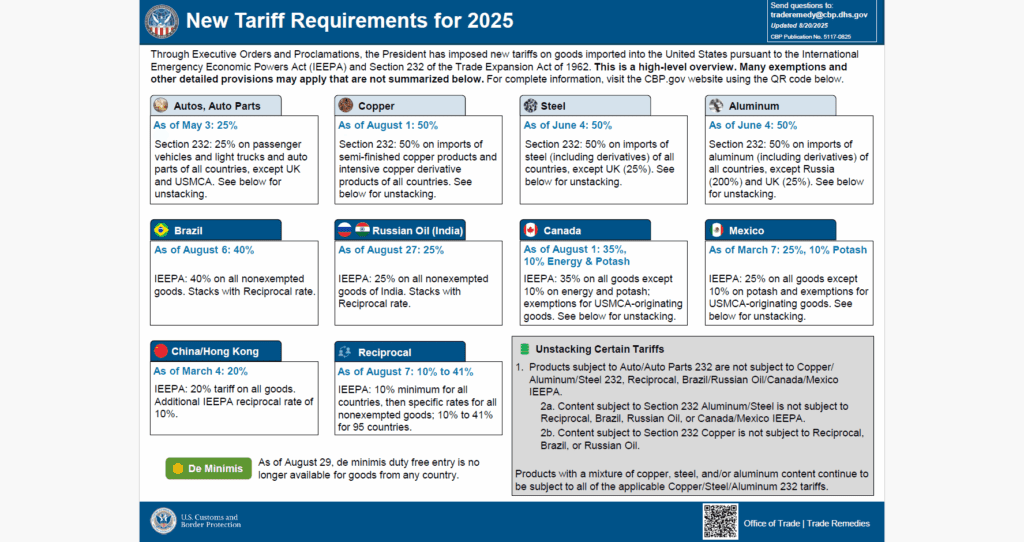
The recent announcement of new tariffs by President Trump is expected to impact global trade flows, supply chains, and shipping costs, particularly for goods crossing U.S. borders.

Key Tariff Updates

  • 10% Baseline Tariff – Effective April 5, 2025, at 12:01 AM (ET).
  • Reciprocal Tariff Rates – Effective April 9, 2025, at 12:01 AM (ET).

These measures will affect trade between the United States and multiple countries. If your business is engaged in importing or exporting goods to or from the U.S., it is essential to evaluate how these changes may impact your shipments, costs, and logistics strategy.

These new tariffs are in addition to the already in place additional tariffs below:

  • International Emergency Economic Powers Act (IEEPA) – additional 20% duty on all Chinese manufactured goods
  • Steel and Aluminium 25% tariffs from ALL countries
  • Steel and Aluminium derivative duties
  • Vehicle & Vehicle Parts

Our team is committed to keeping you informed and minimizing disruptions to your operations. If you have any concerns or require assistance in planning for these tariff adjustments, please do not hesitate to reach out. We are here to provide guidance and support to help you navigate these changes effectively.

Heathrow Airport Closure Impact on Freight Movements

21 March 2025

Note Heathrow Airport is closed today, Friday, March 21, 2025, due to a fire at an electrical substation in Hayes, West London, which has caused a major power outage. Emergency crews are working to resolve the situation, but there is no confirmed timeline for power restoration. This disruption is significantly impacting air freight movements, leading to delays for both imports and exports.

Our team is actively reviewing all affected shipments and exploring alternative solutions where possible. If your consignments are impacted, we will reach out to you directly with updates and contingency plans.

Please do not hesitate to contact us if you have any urgent concerns. We appreciate your patience and will continue to provide updates as the situation develops. +44 161 436 8181

For a call back get in touch:

Contact Us

Ⓒ Future Forwarding 2025. All rights reserved.
Terms of use | Privacy policy | Sitemap | Web Design by Cocoonfx