
U.S. Tariffs on Drugs, Trucks, and Furniture: What Shippers Need to Know

New U.S. tariffs announced last week signal another round of disruption for global supply chains. Effective immediately, the federal government has imposed:

  • A 100% duty on branded pharmaceutical imports, unless manufacturers have broken ground on U.S. facilities.
  • A 25% tariff on heavy-duty trucks.
  • Additional duties on kitchen and bath cabinetry (50%) and upholstered furniture (30%).

While the measures are framed as a national security priority and a boost for domestic industry, the operational reality for importers and logistics managers is more complex.

Rising Landed Costs and Pricing Pressure

Importers of furniture, medical products, and commercial vehicles should expect immediate landed cost increases. For pharmaceuticals and consumer goods, the added duties feed directly into inflationary pressures across the U.S. market. For transportation providers, higher tariffs on heavy trucks may increase the cost of equipment procurement, which can flow down into freight rates and distribution budgets.

Country-Specific Complications

Some trading partners — including Japan and the European Union — negotiated tariff caps on pharmaceuticals. However, no explicit protections were included for furniture or trucks, leaving those sectors fully exposed. British exports of branded drugs are particularly affected, subject to the full 100% duty despite a trade deal earlier this year. Importers sourcing from Vietnam and China, who dominate U.S. furniture flows, are likely to feel the sharpest cost increases.

Compliance and Risk Management

The new tariffs are issued under Section 232 national security authority. That means importers must ensure:

  • Correct tariff classification and declaration of affected commodities.
  • Updated landed cost modeling, including duty, freight, and insurance.
  • Review of supplier contracts and Incoterms to confirm who bears the added costs.

Failure to correctly file under new duty rates could trigger audits, penalties, or shipment delays. Importers should not assume that existing trade deals automatically reduce exposure — the White House has indicated that protections apply only where explicitly written into agreements.

What Shippers Can Do Now

For importers and their logistics teams, a few proactive steps can help mitigate risk:

  • Re-evaluate sourcing: Explore alternate suppliers in unaffected regions or consider U.S.-based options where feasible.
  • Update landed cost analysis: Incorporate new duties into pricing, margin planning, and customer communications.
  • Align with your forwarder: Ensure that filings, cut-offs, and compliance checks reflect the latest duty schedules.
  • Plan equipment budgets: For fleets and carriers, factor higher truck costs into procurement and long-term operating strategies.

Future Forwarding’s View

Global trade rarely moves in a straight line. Tariffs, duty changes, and evolving trade laws can shift market conditions overnight. At Future Forwarding, we monitor these changes closely and work with clients to:

  • Ensure correct tariff filings.
  • Provide visibility into shifting landed costs.
  • Help manage compliance risk across complex supply chains.

The new tariffs are a reminder that vigilance is not optional. Importers that stay informed and align with the right partners can adapt more effectively to uncertainty — and protect their margins in the process.
What the End of the De Minimis Rule Means for UK Exporters Shipping to the US

The recent end of de minimis tariff exemptions in the United States has set off alarm bells across global retail. While much of the commentary has focused on the impact to Asian manufacturing powerhouses, UK exporters are also bracing for change. With the rule change that came into effect on 29 August, shipments under $800 entering the American market are no longer exempt from duties or fees. For UK brands, this shift carries major implications, especially in the e-commerce, direct-to-consumer (DTC), and online fashion sectors.

Why UK Retailers Are Paying Attention

Analysis from retail tech communications provider Flagship shows that UK search interest in “Trump Tariffs” surged by 90% in late August as British fashion retailers and marketplace sellers scrambled to understand the new trade environment. Flagship also reported that searches for “de minimis rule” spiked 52.5% in the week leading up to the deadline, while searches for “US tariffs” climbed 78.9% compared with two weeks prior.

The scale of the UK’s exposure to this policy change is significant. According to Flagship, 41 million de minimis shipments entered the US from the UK last year, making the UK the fourth-largest sender of low-value parcels after China (944 million), Canada (98 million), and Mexico (94 million).

Immediate Cost Pressures

The new structure places flat fees of $80 to $200 per shipment for the first six months, according to the US administration. For small to mid-sized retailers, particularly in fashion and lifestyle goods, this creates a margin squeeze at a time when competition is already intense. The narrow window between announcement and enforcement—just over a month—also left little time for businesses to adapt pricing models or customer communications.

Strategic Shifts Underway

Uncertainty remains, particularly after a recent Court of Appeals ruling challenged the legality of the tariffs. Still, exporters cannot afford to wait on the outcome of a potential Supreme Court review. Data cited by Flagship from Retail Economics indicates that 76% of UK exporters are already diversifying away from the US, with the Middle East and North Africa (MENA) region—especially the UAE—emerging as attractive growth markets.

This trend reflects a broader need for resilience in cross-border trade strategies. Relying too heavily on any one market leaves businesses vulnerable to sudden regulatory or policy changes.

How Freight Forwarders Can Support Retailers

At Future Forwarding, with offices in both the UK and the US, we see this policy shift as more than just a disruption—it is a call to action. Exporters need reliable partners who can help them:

  • Navigate Tariff Complexities: Understanding new fee structures and ensuring compliance is essential to avoid unexpected penalties.
  • Re-evaluate Supply Chains: Reviewing origin points, distribution hubs, and last-mile strategies can mitigate additional costs.
  • Explore New Markets: Expanding into alternative geographies requires freight forwarding expertise, local knowledge, and trusted carrier relationships.
  • Stay Agile: With trade policy in flux, building flexible logistics networks enables companies to pivot quickly when conditions change.

Looking Ahead

The end of the de minimis exemption is a stark reminder that global trade is not static. Exporters who adapt quickly—by diversifying markets, re-engineering supply chains, and working with freight partners who provide proactive guidance—will be best placed to maintain competitiveness.

Future Forwarding remains committed to helping UK and US clients navigate these shifts with clarity, agility, and a focus on long-term growth.

What U.S. Importers Need to Know About 2025 Tariff Changes

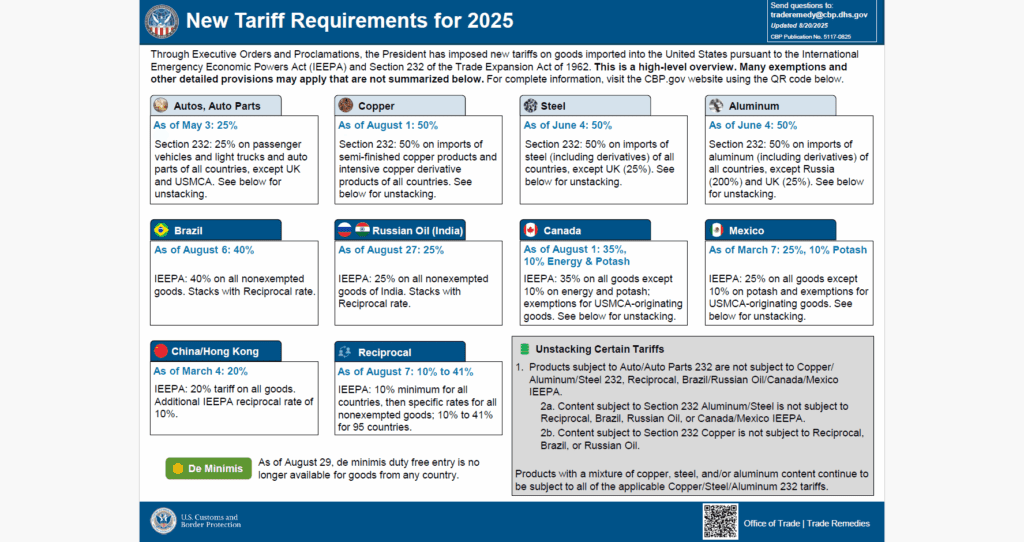
U.S. Customs and Border Protection (CBP) has announced significant tariff changes that take effect throughout 2025. These updates—implemented under Section 232 of the Trade Expansion Act and the International Emergency Economic Powers Act (IEEPA)—impact a wide range of goods, including autos, copper, steel, aluminum, and commodities from key trading partners such as Brazil, Mexico, Canada, China, and India. Shippers, importers, and manufacturers need to prepare now to navigate higher duties, shifting exemptions, and changes to de minimis entry.

Autos and Auto Parts
Beginning May 3, passenger vehicles, light trucks, and auto parts will face a 25% tariff under Section 232. The measure applies to all countries except the United Kingdom and USMCA partners. For companies reliant on imported components, this marks a critical cost factor in 2025 planning.

Metals: Copper, Steel, and Aluminum
Metals see some of the steepest increases:

  • Copper (Aug. 1): 50% tariff on semi-finished copper products and derivatives.
  • Steel (June 4): 50% tariff on imports of steel, with limited UK exemptions.
  • Aluminum (June 4): 50% tariff across all countries, except Russia (200%) and the UK (25%).

These tariffs will sharply impact construction, manufacturing, and infrastructure projects, potentially raising sourcing costs and pushing buyers toward domestic alternatives.

Country-Specific Tariffs

  • Brazil (Aug. 6): 40% tariff on all nonexempt goods, stacking with reciprocal rates.
  • Russia/India (Aug. 27): 25% on nonexempt Indian goods tied to Russian oil trade.
  • China/Hong Kong (Mar. 4): 20% tariff on all goods, plus an additional reciprocal rate of 10%.
  • Canada (Aug. 1): 35% tariff on most goods, but only 10% on energy and potash. USMCA-originating goods are exempt.
  • Mexico (Mar. 7): 25% tariff on most goods, with a lower 10% rate on potash and USMCA exemptions.

Reciprocal Tariffs
As of August 7, all countries face a 10% minimum tariff. For 95 countries, the rate ranges from 10% to 41% on nonexempted goods.

De Minimis Elimination
Starting August 29, the de minimis duty-free threshold will no longer apply. Even low-value imports will be subject to tariffs—removing a key cost-saving strategy many importers have relied upon.

Unstacking Rules
Products falling under multiple categories—such as autos that also contain copper, steel, or aluminum—remain subject to Section 232 tariffs, even if exempt under IEEPA. Importers must carefully review classifications to avoid unexpected duty stacking.

What Shippers Should Do Now

  • Audit Supply Chains: Identify high-risk categories and countries of origin.
  • Revisit Contracts: Update landed cost projections and adjust pricing strategies.
  • Explore Alternatives: Weigh domestic sourcing or trade from exempted countries.
  • Stay Updated: CBP continues to refine guidance; monitoring compliance will be essential.

The tariff landscape in 2025 will be one of the most complex in recent years. Shippers that take proactive steps today will be better positioned to manage costs and maintain supply chain resilience.

For a call back get in touch:

Contact Us

Ⓒ Future Forwarding 2026. All rights reserved.
Terms of use | Privacy policy | Sitemap | Web Design by Cocoonfx