
Explaining MFN and what it means for Russian Imports

As the US and European allies continue to identify ways to punish Russia for Ukraine, last week news broke that one step that governments were planning to take was the revocation of the country’s Most Favored Nation trade status, or MFN. Whether you realize it or not, MFN is what allows most importers to enjoy favorable duty rates on goods imported into the United States and losing this status not only puts duty rates at a higher level, but also sets the stage for imports to be banned entirely.

For importers, the details of MFN status are laid out in the beginning of the Harmonized Tariff Schedule, or HTS.


There are only two countries right now that do not enjoy MFN status with the United States: Cuba and North Korea. That list alone should be a significant indicator of the severity of the relationship a country would (or wouldn’t) have with the United States to be included.

When determining classification in the HTS, after the proper tariff number is located, the question then is whether or not the exporting country is eligible for Column 1 duties (the lower, preferable rate) or Column 2 duties (the higher, prohibitive rate). The idea behind the stark difference is that US buyers who want to select between identical merchandise purchased from a friendly trading nation versus an unfriendly one will find little market for a product priced far more expensively and therefore choose a country with MFN status.


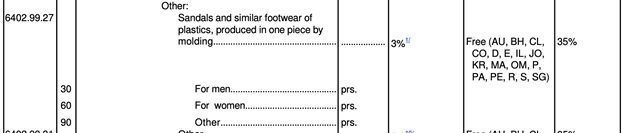
Take, for example, this page from the tariff for footwear showing the difference in duty rate for Column 1 versus Column 2 countries.
MFN

Sandals from a friendly country are 3% – from a Column 2 country, 35%.


Aside from the outright prohibition for entry that the administration announced on oil, seafood and diamonds, other products such as steel, iron or aluminum will see additional duties as well. It is likely that Russia’s actions and reaction here in the United States will, by and large, eliminate a buyer’s appetite for these products unless they absolutely cannot be procured elsewhere, but that remains to be seen based on the length of time sanctions will remain in place.


The steps taken by governments continue to evolve and move rapidly, and Future Forwarding’s compliance team is committed to monitoring announcements by governments in the US, UK and EU and proactively advising our clients if products they source or ship could be caught up in trade action.

Port congestion creeps across east coast

The good and bad news of container congestion should be able to balance each other out as the US west coast finds a bit of relief while east coast ports take on diverted ships and cargo, building delays on the Atlantic side from Asia. However, the scales aren’t truly balancing at this point and there are concerns the relief on the west coast is less from actually catching up on backlogs and more from the reduction in departures from Asia during the Lunar New Year Golden Week public holiday. 


According to John McCown, publisher of the McCown Report, “January was the eighth straight month where overall growth at East/Gulf Coast ports exceeded overall growth at the West Coast ports.” He attributed the trend to “shippers changing routing decisions to avoid the widely reported West Coast congestion.”


The numbers check out on his assessment. In Charleston alone, 31 ships are delayed waiting for space, the number of ships calling the port from Asia is up 12.7% over 2021 number and 47% higher than a decade ago. In the midst of more ships, carrying larger quantities of cargo, dwell time is also climbing in Charleston, now 37% above average. 


The relief that the west coast saw in February came from a lull in departures during the final weeks of January – 22% below average the week of January 17, 2022, and 30% below average the week of January 24th. Fewer ships on the water, more ships headed to the east coast, more disruption on the horizon as departures in March and April are expected to be 40% higher than average. 


One of the biggest problems with the unbalanced traffic is that there isn’t an equal split of work that is able to be done on both coasts. Ports like Charleston cannot compete with the number of containers that LA and LB can service. The west coast can have a record of 109 ships waiting in San Pedro Bay but their throughput speed is significantly faster than Charleston so it’s much easier for California to catch up on bigger backlogs than any other port in the United States. 


When considering the best routing for cargo, we need to remember that while there are still delays on the west coast, those delays arose out of a behemoth port that has grown to accommodate massive cargo imports but wasn’t quite ready for the increase of pandemic stressors. 


Early decisions by carriers to divert ships, blank sailings, and reroute cargo and PPE in early 2020 caused a domino effect of disruption and that’s the last thing we need to do now. Many shippers are looking to try reinventing the wheel, divert cargo to a different routing and completely overhaul the supply chain for the sake of saving a week here and there. 


Yes, west coast delays are not going away any time soon, but we urge our ocean import customers to talk to Future Forwarding about their needs, their time requirements, equipment, and current projects before making any changes. We’re ready to assess each situation to the best of our understanding and provide real-world solutions in a workable and consistent manner to ensure the delays impact our clients as little as possible. We look forward to hearing from you and helping you keep your cargo moving.

Benefit ABC’s of the FTZ

When is a foreign country not a foreign country for the purposes of customs, manufacturing, and duty assessment? When it’s actually here in the United States, is called a Foreign Trade Zone (FTZ) and allows U.S. companies to perform a wide spectrum of activities, all of which can delay payment of duties, reduce costs through a single entry fee, and cap Merchandise Processing Fees. As a bonus, it allows goods of multiple classifications and ad valorem duties to be imported, manufactured, and be removed, or “exported,” as a different finished product at an even lower duty rate, or even potentially duty-free. 

Foreign Trade Zones (FTZ) are secure and cost-effective options for importers who need cargo held indefinitely or have cargo that will undergo an alteration such as manufacturing, mixing, assembly or repair.  Most merchandise can be imported into an FTZ without formal customs entries or duties, which aren’t required until the goods enter the commerce of the United States. In a specifically designated location under FTZ rules, goods are still considered “international commerce” which means duty can be deferred until the goods leave. 


There are a number of benefits of using an FTZ:

  • Duty deferral – Duties aren’t due until the goods leave the FTZ.
    • Inverted tariff relief – if components or raw materials have a higher duty than finished goods, an FTZ allows manufacturers to pay the lower cost. Further to this, manufacturers won’t pay duties on waste, scrap, and loss as the finished goods are all that leave the FTZ as US consumer goods. 
    • Duty-free re-exports – If goods are entering the US just to be reexported to another country (Canada and Mexico being exceptions with their own rules and duties) an FTZ can act as an international point because technically the goods aren’t in the US and don’t have to pay duties. 
    • Single entry filings – using an FTZ means that an importer only needs to file a single Customs entry each week instead of filing one for each shipment. 
    • Inventory storage – Goods can be held at an FTZ for an indefinite period so cargo with quota restrictions is handled and duty is deferred permanently if the goods never leave. 
  • Enhanced security and tracking – FTZ’s by their very nature are tightly controlled. 
  • Easier identification and classification – this can be done at the FTZ and not at a port or Customs control location. 


While there are exceptions to every rule, a Foreign Trade Zone offers a number of valuable solutions across 193 active FTZ programs across the United States, at approximately 3,300 businesses, and importing over $767 billion in shipments. If you’re interested in learning more about how your cargo can benefit from adding an FTZ to the routing, reach out to your Future Forwarding representative today to discuss the benefits available to you. 

COVID Keeping Delays Consistent in China

The “COVID-zero” strategy throughout China and Hong Kong threatens to drive up logistics costs by 40% and drive down capacity to one-fifth of pre-pandemic levels as cities around Beijing restrict travel in response to new cases. Airports, highways, railways, ports, and other transportation sectors in Shenzhen, which shares a border with Hong Kong, are stepping up pandemic control measures as small outbreaks of the COVID-19 Omicron variant pop up in Tianjin, Xian, and Guangdong, China. 


With Cathay Pacific canceling hundreds of flights and the Port of Tianjin and airport suspending all pickup operations, the situation is stretching the supply chain to the breaking point. The omicron variant ended a three-month streak without local transmissions in Hong Kong where a two-week ban on incoming flights from eight countries is in effect until at least January 20th. 

In Shenzhen (an area where previously the most recent case was in May of 2020), two confirmed cases of COVID-19 have a contract tracing footprint of 123 people, some of who are isolated on a cruise ship that is now quarantined in the harbor pending testing. The fear of silent transmission chains has seized the cities leading to travel restrictions pending a negative test within 48 hours and requiring commuters to work from home rather than move between cities.


Because authorities in Shenzhen determined that it was highly likely that exposure came from a contaminated cargo shipment extra precautions are being taken at ports and airports to protect handlers from coming into contact with COVID-19. The added security measures will further delay cargo processing in addition to the reduction in workers as companies test and adopt enhanced screening procedures. 

Apart from ports and airports, highways and railways are experiencing delays, especially in the trucking sector as many warehouses turn away drivers from outbreak impacted areas. Last week, trucking operations at the Port of Ningbo were delayed by testing and this week trucking around Jinhua Yongkang is suspended pending testing results. 


Because Future Forwarding is dedicated to providing individualized supply-chain solutions to a range of businesses we encourage our clients to reach out for more information and ideas on how we can mitigate the delays we are facing. We know this could mean last-minute changes to carriers or modes of transport which could come with additional costs, but will do our best to mitigate or prevent them wherever possible.

Uyghur Forced Labor Prevention Act Impact

On December 23rd, President Biden signed into law the Uyghur Forced Labor Protection Act. The legislation passed Congress by huge margins in the House and Senate and seems to be one of the few places that both sides of the aisle can find common ground – China’s human rights record.

It becomes law 180 days from the date of signing so on June 21, 2022, all products of the Xinjiang Uyghur Autonomous Region, or XUAR, will be prohibited entry into the United States based on the supposition and grounds that the goods were “mined, produced or manufactured” using forced labor.


The United States has consistently been focused on this issue across multiple previous administrations with presidents from both parties. CBP has notably been taking steps to issue Withhold Release Orders for companies and entire product groups from this province in western China and the Act is a strong, codified step that requires importers to take a closer look at their entire supply chain to determine whether any part of it runs through Xinjiang.

The Act can be read here, but in brief, a Forced Labor Task Force will be charged with soliciting comments and receiving public testimony. They will then adjudicate those comments and, in consultation with State, Commerce, DHS (CBP) and the Director of National Intelligence (DNI), develop the policy framework of how the law is to be implemented. 

While many of the details are yet to be worked out, there is language in the Act which provides a means by which companies can present evidence to the government to be reviewed and, if deemed conclusively not produced with foreign labor, will be exempted and this exemption will be published no later than 30 days after the exemption determination is reached.

Importers will need to focus on three key things in the coming weeks and months.

  1. A wholesale review of supply chains and components to determine whether or not ANYTHING on a product’s bill of materials, no matter how low, originates in Xinjiang.
  2. If exposure to the law exists, speak with Future Forwarding to help submit comments or testimony, or refer to legal counsel to request an exclusion when the details are released.
  3. Expand the Xinjiang component search to countries outside China because goods could still be denied entry if further manufacturing or assembly happened in a third country and it is determined the item contains XUAR-originating components.


Like everything else that companies have dealt with through 2020 and 2021, this is just another challenge in the new year. Fortunately, Future Forwarding and our team of compliance experts and outside counsel are ready to help clients conduct the necessary reviews and be ready for June 21, 2022.

Fees Suspended as Congestion Clearing Improves

On October 25th, the ports of Los Angeles and Long Beach announced the Container Dwell Fees, as well as a plan to run operations at the ports at 24/7 capacity. Carriers would have 9 days to move containers by truck and 6 days to move by rail. Each container would be charged $100 for each day lingering.

The terminals were running out of space, and the executive directors were hoping to make room for the containers sitting on the ships at anchor. There have been dozens of cargo ships anchored offshore from the two ports for months, leading to a supply chain crisis nationwide. Partly due to the shortage of warehouse workers, and truck drivers to pick up the goods, this ongoing crisis is continuing to plague the nation. However, unloading the ships has brought up new problems, such as the surrounding neighborhoods being used for storage, and trucks idling for hours in the residential streets. 


Despite this, LA and LB California ports are delaying the imposing fines on the carriers for idle containers awaiting pick up, saying that there has been a significant improvement in the supply chain since last month. The executive directors of the ports said in a joint statement that since the announcement in October for the compounding fees, the two ports have seen a tremendous decline of 33% in aging cargo on the docs. Though they are satisfied with the progress so far, the directors will continue to monitor the situation and will reassess the implementation of the fee in the upcoming days after Black Friday and Cyber Monday. 


The gift-giving season is here, and this development came with the supply chain squeeze that occurs every year around this time. President Joe Biden’s administration, in an attempt to relieve the pressure on the supply chain, still contends with inflation, a labor shortage, and elevated levels of COVID-19 cases.


As the crisis continues to hopefully improve, you can count on Future Forwarding to make sure your cargo is getting where it needs to go. We know each company has specific needs and we are here to make sure we meet each and every one of them. Whether by air, sea, or ground, we have the resources and expertise to work to deliver every shipment in a timely, secure manner. At Future Forwarding, we deliver personalized quality every step of the way.

More Stick than Carrot: the latest plan to clear the Southern California backlog

It’s only 60,000 containers by November 1st that have to get moved, right? Totally doable. 


Or not.


This week, the ports of Los Angeles and Long Beach decided the best way to get the 33,000 and 27,000 containers that have overstayed their welcome at their respective properties moving was to start charging the squatters penalties in hundred dollar increments.

The fee is to be assessed on local delivering cargo only and is designed to force importers and warehouses to take possession of containers rather than utilizing the ports as a cheaper storage location for warehouses that may already be overflowing and unable to receive more cargo.


Local delivering cargo will be assessed the fee after 9 days and rail delivery cargo after 3 days. The fee is $100 per day – but the problem is that it compounds to $200 on the second day, $300 on the third day, etc., etc.

The idea was hatched from a regularly scheduled meeting between the ports and White House Port Envoy John Pocari. With the daily average of container ships at anchor over seventy vessels and 24-hour operations not seeing the widespread adoption, they thought it would, ports have turned to the stick-in “carrot and stick” approach to incentivize the cargo to move through the backlog.


When the surcharges begin on November 1st, an estimated 60,000 containers on the terminals would be subject to the fee. The problem is it isn’t as simple as removing the container from the terminal. Critical chassis shortages and increased turn times have led to an inability of truckers to utilize all the appointments that are available because there are simply too many containers and not enough wheels.

The ports will pass this along to the carriers. Carriers, particularly those doing store door deliveries, will inevitably pass the charge along to their clients. Shippers forced to wait for a carrier’s equipment availability days after they are capable of receiving the container will undoubtedly be saddled with this fee, along with the demurrage and detention fees already applied.


We continue to work diligently to deliver containers to our clients as quickly as possible through the backlog, encouraging them to prioritize containers coming available to stop these penalty provisions that are adding hundreds and thousands of dollars to already record-high freight rates. For more information on this new challenge in Southern California, contact your Future Forwarding representative today.

Textile Troubles: Why southeast Asian supply chains are slowing

Companies seeking relief from China Section 301 tariffs, as well as seeking to take advantage of lower-cost labor, made the move to more developing nations in hopes of diversifying their supply chains pre-pandemic. While an idea with merit, the relocation of factories or component manufacturers requires a trained workforce, factories and more importantly, the means to get goods to buyers. 


For textile and apparel manufacturers, countries like Vietnam and Bangladesh held – and still do hold – great promise. However, with decreased passenger travel and another wave of Delta racing around the globe, these countries are also over-exposed to risk while their populations are woefully under-vaccinated.


According to data from the World Health Organization, as of September 27th a little over 26% of Vietnam’s population had received at least one vaccination dose and only 22% of the country is fully vaccinated. Bangladesh is even lower, with 14% having received one dose and 9% being fully vaccinated. Companies seeking relief from China Section 301 tariffs, as well as seeking to take advantage of lower-cost labor, made the move to these developing nations in hopes of diversifying their supply chains.

The low vaccination percentages mean that governments have only one recourse to restrict the spread of the virus – extreme lockdowns similar to what western countries imposed in early 2020 when there was little knowledge about how the virus was spread. 


That knowledge is today informing how countries, cities or states take action to protect their populations from further exposure and from overrunning their health care capacity. For Vietnam’s textile manufacturing sector, measures taken in and around Ho Chi Minh meant a third of the factories were unable to operate.

The lockdowns, slated to end mid-September, now run through the end of the month. This shutdown came at a time when Vietnam passed Bangladesh for the second spot on the WTO’s list of largest textile exporters. Small to medium-sized brands aren’t the only ones feeling the pressure. Global companies such as Nike have disclosed that they lost ten weeks of apparel and footwear production in Vietnam and it will take several months to return to full output.


Of course, these countries do not possess the huge network of containers, infrastructure and deep-water ports to command direct calls from vessels that are being held up in San Pedro here in the United States and increasingly at Chinese ports as well. So for the factories which are operating, securing equipment and space is even more difficult than in other, more developed parts of the Asian supply chain.

For exporters from countries like Vietnam, Cambodia and Bangladesh, this means adapting supply chains to prioritize high-value, most in-demand products and utilizing air freight when and where possible. Future Forwarding is focused on continuing to monitor the situation in these countries which are important to the textile and apparel sector and delivering important updates on rates, capacity and options for our customers’ supply chains.

The FMC Wants to Hear from You

Submit comments to the FMC about demurrage, detention, and service issues

The National Customs Brokers and Forwarders Association of America has reached out to member companies like ours imploring us to have shippers, both importers and exporters, submit written comments to the Federal Maritime Commission on the shipping practices of carriers during the pandemic.

If you are an importer or exporter who holds a direct contract with a line, you’ve had first-hand experience begging, imploring, likely shouting and finally relenting in the face of the take-it-or-leave-it approach to negotiations that carriers have adopted over the past year or so. For everyone else, Future Forwarding and companies like ours have been the ones doing all this on behalf of all of our shippers, putting us in some very uncomfortable positions trying to advocate for all while jeopardizing none.

We can – and will – submit our own written comments to the agency about our experiences which have been on both transatlantic and transpacific routes – inequity, it seems, isn’t playing favorites.

The FMC, for its part, is increasing its engagement and involvement, as are other government agencies like the Surface Transportation Board with jurisdiction over the charges, actions, and practices of railroads.

On August 4th

The agency announced an expedited inquiry into the timing and legal sufficiency of these charges. This inquiry is being led by the agency’s Bureau of Enforcement and demonstrates their interest in taking action, if and when warranted.

FMC Commissioner Rebecca Dye submitted an interim report with a number of suggestions, including Congressional actions, to strengthen and hold carriers accountable for their behavior towards shippers.

Please submit comments to the Federal Maritime Commission.

Here’s how to do it.

  1. If you have a specific complaint you want to file for a monetary loss or dispute, start here, on the agency’s page for “Filing a Shipping Act Complaint”.
  2. If you wish to submit a letter to the FMC for a specific shipment or shipments include details such as carrier name, master bill of lading number(s), container number(s), the violation or offense that took place and what attempts you have made, if any, to mitigate or resolve the matter with the carrier.
  3. If you wish to submit a general letter to the FMC as a shipper who has been affected, that’s acceptable as well. Be sure to include details about your experiences, the economic and commercial impact, the impact on jobs or the health of the company, and if you have been able to find any alternate solutions to problems surrounding rates, service failures, surcharges, or other supply chain breakdowns.

The letters can be emailed to the Secretary of the FMC at secretary@fmc.gov.

The agency’s interest as well as that of other associations such as the National Retail Federation, the US Chamber of Commerce, and others means that the more voices raising the issue impress upon the agency the urgency to help the shipping public. We are happy to review and share feedback on your letters to the agency. 

While we cannot envision things improving overnight, a persistent drumbeat of pressure on steamship lines and railroads to deliver service and not profiteer in the time of a crisis that is partially real and partially manufactured is a good first step towards improvement.

Feds respond to supply chain woes

Multiple federal agencies scrutinizing supply chain performance, costs.


As shippers ponder whether or not today’s freight rates will remain this way into next year and panic over Drewry’s analysis showing container port capacity may remain this constrained until 2025, shippers are making tough choices when it comes to their supply chain and what cargo to ship and what to leave behind – or cancel altogether. This, coupled with the checks they are writing for demurrage and detention penalties to marine terminal operators, carriers, and railroads have had consequences ranging from jeopardizing end-to-end domestic supply chains to denying service to exporters.

With July drawing to a close and the traditional peak season on the transpacific slated to begin in earnest, cargo owners who have felt taken advantage of for the past year or so are taking note of the federal government’s stepped-up interest and actions in ocean shipping and railroad practices. While they’ve not noticeably intervened yet, a few of the more notable actions they’ve taken, plus potential Congressional action, should be on the minds of our customers hoping that maybe this time the phrase, “I’m from the government, I’m here to help,” will mean something for their supply chains.


The Federal Maritime Commission has jurisdiction over ocean shipping. They regulate companies like ours who require a license to offer ocean transportation services as well as the carriers who operate the vessels. Last year, the FMC opened a Fact-Finding into the demurrage and detention practices of ports when containers were trapped on terminals unable to be recovered but cargo owners were nonetheless being charged. 

The situation escalated when American exporters were unable to secure equipment because carriers were sending empties back to Asia to load with more profitable cargo rather than repositioning boxes. 

These activities became the subject of a subcommittee hearing in the House of Representatives.


Earlier this month, the President signed an Executive Order focused on competitiveness and targeted industries that were exhibiting monopolistic and antitrust behavior. Called out specifically were ocean lines and Class 1 railroads, both of whom the Executive Order directed regulatory agencies to investigate. For carriers, the FMC, for railroads, the Surface Transportation Board.


That was on a Friday. The following Monday, the FMC announced the signing of their first-ever interagency MOU with the Justice Department to announce shared resources and initiatives to investigate antitrust behavior by shipping carriers. Then, they unveiled their plan to audit the demurrage and detention practices of the nine largest carriers by market share.

The Surface Transportation Board then announced their intention to force railroads to open their books to investigate their charging practices, especially given the fact that in some cities the time to recover a container was measured in weeks, not days, and they were collecting thousands of dollars in fees per box.

As if both sets of companies didn’t have enough to worry about with this sudden interest in their practices and record profitability, Congress is drafting legislation that would rewrite the US shipping laws and curb the ability to assess these record-level punitive charges.


Is the cloud over the horizon the thundering hooves of the cavalry, or just another dust storm of bluster and little else? At this point, it’s hard to tell. But for those who’ve been in the logistics business for a few decades, the early 00’s saw the Justice Department indict, prosecute, and send to prison air cargo executives from global airlines for price-fixing of surcharges. They’ve gone after other industries before, and given the precipitous decline in the number of carrier and rail choices because of mergers and consolidation, a handful of companies are all comporting themselves in identical fashion – a behavior that could cost them sometime in the future.

For a call back get in touch:

Contact Us

Ⓒ Future Forwarding 2025. All rights reserved.
Terms of use | Privacy policy | Sitemap | Web Design by Cocoonfx