
Explaining MFN and what it means for Russian Imports

As the US and European allies continue to identify ways to punish Russia for Ukraine, last week news broke that one step that governments were planning to take was the revocation of the country’s Most Favored Nation trade status, or MFN. Whether you realize it or not, MFN is what allows most importers to enjoy favorable duty rates on goods imported into the United States and losing this status not only puts duty rates at a higher level, but also sets the stage for imports to be banned entirely.

For importers, the details of MFN status are laid out in the beginning of the Harmonized Tariff Schedule, or HTS.


There are only two countries right now that do not enjoy MFN status with the United States: Cuba and North Korea. That list alone should be a significant indicator of the severity of the relationship a country would (or wouldn’t) have with the United States to be included.

When determining classification in the HTS, after the proper tariff number is located, the question then is whether or not the exporting country is eligible for Column 1 duties (the lower, preferable rate) or Column 2 duties (the higher, prohibitive rate). The idea behind the stark difference is that US buyers who want to select between identical merchandise purchased from a friendly trading nation versus an unfriendly one will find little market for a product priced far more expensively and therefore choose a country with MFN status.


Take, for example, this page from the tariff for footwear showing the difference in duty rate for Column 1 versus Column 2 countries.
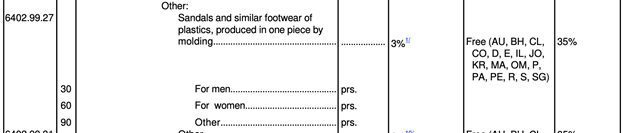
MFN

Sandals from a friendly country are 3% – from a Column 2 country, 35%.


Aside from the outright prohibition for entry that the administration announced on oil, seafood and diamonds, other products such as steel, iron or aluminum will see additional duties as well. It is likely that Russia’s actions and reaction here in the United States will, by and large, eliminate a buyer’s appetite for these products unless they absolutely cannot be procured elsewhere, but that remains to be seen based on the length of time sanctions will remain in place.


The steps taken by governments continue to evolve and move rapidly, and Future Forwarding’s compliance team is committed to monitoring announcements by governments in the US, UK and EU and proactively advising our clients if products they source or ship could be caught up in trade action.

Benefit ABC’s of the FTZ

When is a foreign country not a foreign country for the purposes of customs, manufacturing, and duty assessment? When it’s actually here in the United States, is called a Foreign Trade Zone (FTZ) and allows U.S. companies to perform a wide spectrum of activities, all of which can delay payment of duties, reduce costs through a single entry fee, and cap Merchandise Processing Fees. As a bonus, it allows goods of multiple classifications and ad valorem duties to be imported, manufactured, and be removed, or “exported,” as a different finished product at an even lower duty rate, or even potentially duty-free. 

Foreign Trade Zones (FTZ) are secure and cost-effective options for importers who need cargo held indefinitely or have cargo that will undergo an alteration such as manufacturing, mixing, assembly or repair.  Most merchandise can be imported into an FTZ without formal customs entries or duties, which aren’t required until the goods enter the commerce of the United States. In a specifically designated location under FTZ rules, goods are still considered “international commerce” which means duty can be deferred until the goods leave. 


There are a number of benefits of using an FTZ:

  • Duty deferral – Duties aren’t due until the goods leave the FTZ.
    • Inverted tariff relief – if components or raw materials have a higher duty than finished goods, an FTZ allows manufacturers to pay the lower cost. Further to this, manufacturers won’t pay duties on waste, scrap, and loss as the finished goods are all that leave the FTZ as US consumer goods. 
    • Duty-free re-exports – If goods are entering the US just to be reexported to another country (Canada and Mexico being exceptions with their own rules and duties) an FTZ can act as an international point because technically the goods aren’t in the US and don’t have to pay duties. 
    • Single entry filings – using an FTZ means that an importer only needs to file a single Customs entry each week instead of filing one for each shipment. 
    • Inventory storage – Goods can be held at an FTZ for an indefinite period so cargo with quota restrictions is handled and duty is deferred permanently if the goods never leave. 
  • Enhanced security and tracking – FTZ’s by their very nature are tightly controlled. 
  • Easier identification and classification – this can be done at the FTZ and not at a port or Customs control location. 


While there are exceptions to every rule, a Foreign Trade Zone offers a number of valuable solutions across 193 active FTZ programs across the United States, at approximately 3,300 businesses, and importing over $767 billion in shipments. If you’re interested in learning more about how your cargo can benefit from adding an FTZ to the routing, reach out to your Future Forwarding representative today to discuss the benefits available to you. 

More Stick than Carrot: the latest plan to clear the Southern California backlog

It’s only 60,000 containers by November 1st that have to get moved, right? Totally doable. 


Or not.


This week, the ports of Los Angeles and Long Beach decided the best way to get the 33,000 and 27,000 containers that have overstayed their welcome at their respective properties moving was to start charging the squatters penalties in hundred dollar increments.

The fee is to be assessed on local delivering cargo only and is designed to force importers and warehouses to take possession of containers rather than utilizing the ports as a cheaper storage location for warehouses that may already be overflowing and unable to receive more cargo.


Local delivering cargo will be assessed the fee after 9 days and rail delivery cargo after 3 days. The fee is $100 per day – but the problem is that it compounds to $200 on the second day, $300 on the third day, etc., etc.

The idea was hatched from a regularly scheduled meeting between the ports and White House Port Envoy John Pocari. With the daily average of container ships at anchor over seventy vessels and 24-hour operations not seeing the widespread adoption, they thought it would, ports have turned to the stick-in “carrot and stick” approach to incentivize the cargo to move through the backlog.


When the surcharges begin on November 1st, an estimated 60,000 containers on the terminals would be subject to the fee. The problem is it isn’t as simple as removing the container from the terminal. Critical chassis shortages and increased turn times have led to an inability of truckers to utilize all the appointments that are available because there are simply too many containers and not enough wheels.

The ports will pass this along to the carriers. Carriers, particularly those doing store door deliveries, will inevitably pass the charge along to their clients. Shippers forced to wait for a carrier’s equipment availability days after they are capable of receiving the container will undoubtedly be saddled with this fee, along with the demurrage and detention fees already applied.


We continue to work diligently to deliver containers to our clients as quickly as possible through the backlog, encouraging them to prioritize containers coming available to stop these penalty provisions that are adding hundreds and thousands of dollars to already record-high freight rates. For more information on this new challenge in Southern California, contact your Future Forwarding representative today.

FCL Not Available? Think LCL Instead.

Scheduled LCL as a viable option when FCL is unavailable

In the days of plentiful containers, on-time schedules and fluid ports, the decision whether or not to pay a flat rate for a full container versus per cubic meter for less than container load was never in doubt for most logistics managers. Now, with rates spiraling out of control and space allocations being how most cargo gets moved, the advantages to LCL shipping are outweighing the disadvantages.

If you’re new to contemplating LCL, we should probably start with what is LCL before moving on to why LCL is a better choice in today’s market environment.

Ocean freight moves in containers. What is inside those containers falls into one of three groups:

  • A full container that is loaded at a single origin factory for a single recipient at the destination.
  • A buyer’s consolidation in which freight from multiple suppliers is consolidated into that container for a single buyer or recipient at the destination.
  • A groupage container in which cargo from multiple shippers for multiple consignees is combined and shipped together.

Future Forwarding provides weekly scheduled LCL service between the United Kingdom and the United States, keeping our customers’ cargo moving on a stable, somewhat reliable schedule.

Each week, we commit to receive cargo until the closing date, the date that we stop accepting freight to load into the container. We then take all of the cargo in our possession, play a three dimensional game of Tetris to determine the optimal loading to maximize the space inside the container and give the loaded container to a steamship line.

That container with multiple cargo owner’s merchandise sails to the United States where it is taken to a deconsolidation warehouse to be separated into the same lots that were given to us at origin. Each of those shipments separately clears Customs and can be delivered after it is released and available.

We have discovered across our network that the cargo which moves the most reliability at this point is regularly scheduled less than containerload cargo. We have weekly confirmed bookings and equipment based on contracts and commitments we established and, by and large, carriers are honouring those contracts.

Unlike FCL, which comes with flat rate costs for ocean freight, bunker and terminal charges, the shipping costs and handling charges for less than container load are based on the weight, the volume or some combination of both. The extra handling that comes with loading and unloading the cargo containers at origin and destination adds cost, as well as the cargo being priced per cubic meter of space inside the container versus buying the entire container.

Future Forwarding has offices in both the United States and United Kingdom and  are currently offering fixed-day weekly sailings for cargo between the United Kingdom and the United States.

For importers who order a monthly full container, working with their suppliers to ship whatever is produced weekly via LCL means a steady stream of cargo into their supply chains, avoiding additional weeks of delay after readiness waiting for equipment, a sailing or both. For companies who are unable to secure air freight capacity or for whom delays at origin or destination are causing gaps, LCL is a viable alternative.

At Future Forwarding, we understand that less than containerload may not be your first choice. It may not be your best option. It might, in all honesty, be your least worst option until rates, equipment and services have stabilized and become predictable and easier to demand forecast. Regardless of your reason for investigation less than container load, Future Forwarding is here to help.

Contact us for more information about our weekly LCL consolidation rates and schedule

FUTURE FORWARDING AND REVERSE LOGISTICS

Because shipments are now leaving warehouses for consumers rather than exclusively distribution centers or retailers, the need to have a process for managing customer-level returns is of increasing importance to e-Commerce sellers. An entire association has in fact come into being because of this need. Reverse logistics management is one of the most rapidly growing sectors of e-Commerce management and fulfillment.


The buying and return management needs of goods owners in sectors such as footwear and apparel are far different because their customers are buying differently than a company selling home furnishings or consumer electronics. Garment and footwear importers and cargo owners cannot rely on a one-size-fits-all returns solution offered by just any provider. The specific returns management solutions that Future Forwarding offers differentiate us from the competition.


As detailed in this recent BBC article, consumers who are choosing not to go to stores – or who pre-pandemic were already purchasing these items online – may be unsure of the size they need. Instead of buying one, they may buy two, three or even five versions of the same garment or shoe, bracketing a range of sizes to find the one that fits just right. 


For the seller, it means carrying additional inventory and carefully forecasting their selling price to accommodate the inherent cost of processing a return of 50 – 80% of the initial shipment. 


For the logistics company, it increases the number of picks for a single order and creates a bidirectional flow of freight into and out of their warehouse, including designing a process to inspect, repackage and prepare a product to leave the warehouse for a second or perhaps even third time.


Future Forwarding has at its core deep experience in handling reverse logistics for garment and footwear importers. We have designed systems that involve inventorying, picking and shipping seasonal orders to traditional brick and mortar stores operated by department stores as well as the brands themselves. At the end of a season, items may be returned to be cleaned, hung, have small repairs made and bide their time to go back out the next year. 


The same systems that we use to send and receive these large pick-and-ship orders are immediately translatable to individual e-Commerce orders destined directly for the purchasers. 


  • We maintain comprehensive on-hand and inbound inventory visibility at style, size and SKU level. This ensures accuracy for online stories and also helps the cargo owners determine whether or not a single or multiple shipments will be required to fulfill a single order.
  • Future Forwarding has designed and optimized our warehouses and deployed technology for our employees that allows them to receive, prioritize and fill orders using rules that we or our customers have set.
  • Our locations in the Atlanta metropolitan area put us within immediate reach of a significant percentage of our customers’ audiences in as little as three days for most ground-based parcel services.
  • We have garment-on-hanger and footwear specific racking.


There are warehouses who talk about e-Commerce fulfillment and their ability to pick and pack for garment and footwear companies – and then there is Future Forwarding.


Contact us today for a virtual or in-person tour of any of our buildings or to learn how we can become your e-Commerce fulfillment provider on the back of our strength in return logistics management.

3PL customer participating in GMA “flash sale”, promoting small businesses

A newly established 3PL client participated in a Good Morning America flash sale.

The show focuses on promoting small businesses, new products, and up-and-coming designers producing a high volume of sales.

Participation requires stand-alone IT integration and a 72-hour shipping window.

In the past, our client used a warehouse referred by show organizers to process a high volume of orders.

Unfortunately, there were numerous challenges with some orders e.g.: wrong products sent, incorrect addressing, and unprocessed orders.  These challenges resulted in customer service issues jamming our client’s communications systems and led to complaints from show organizers.

Fortunately, our client had moved into a Future Forwarding facility two months earlier, notified us of the pending sale, and introduced us to the show’s IT consultant three and a half weeks before the show.

As the show date got closer, our in-house IT team configured the flash sale e-com site into our WMS for order fulfillment, shipping, and customer confirmation messaging.

All systems passed testing and were set to “go-live.”

In IT testing, the IT consultant forwarded standard orders which were received and processed without fail.

When the actual sale opened on a Saturday morning, some orders were made via electronic payment methods, populating a data field that was previously identified as “blank.”  The appearance of this data caused batched orders to fail.

Future Forwarding’s IT team was notified of the problem.  They gained remote access to the system, identified, and resolved the issue with less than an hour of downtime in the warehouse.

The IT team also discovered that the client’s “from” e-mail was restricted to 2500 outbound messages per day, so they replaced it with an address on the Future Forwarding domain to provide timely shipping and tracking information to consumers.

Order fulfillment and accuracy rate was and astounding 99.9001%!

Show hosts immediately asked our client to return for future participation.

Future Forwarding conducted a post-sale debrief with our client and agreed to future sale activities and sales activities with other third-party promoters.

Future Forwarding Featured in Business View Magazine

When Business View focused on supply chain and logistics in its February 2019, two of our vice presidents had a chance to speak about the ways our company boosts the efficiency of our clients. Based on interviews with Pam Brown and Shannon Whitt, the article highlighted Future Forwarding’s vision, history and growth, emphasizing our customized approach to every stage of the supply chain.

“We’re not everything to everyone, and we don’t try to be,” Whitt told the magazine. “We customize, whether that be import, export, warehousing, or domestic.  We provide options to our clients, but we’re still very focused on doing what we do best. And we make sure we can handle it properly and economically before we commit.”

Read the Entire Article

For a call back get in touch:

Contact Us

Ⓒ Future Forwarding 2026. All rights reserved.
Terms of use | Privacy policy | Sitemap | Web Design by Cocoonfx